Table of Contents
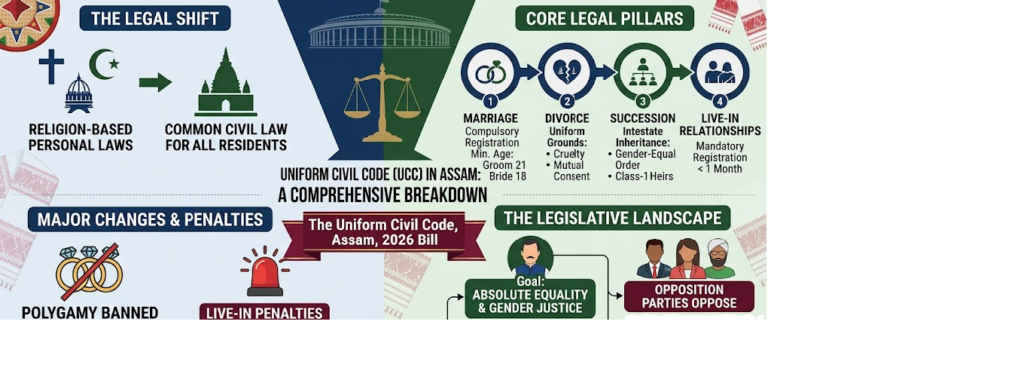
The Assam government recently tabled ‘The Uniform Civil Code, Assam, 2026 Bill’ in the State Assembly. The Bill proposes a common law for all residents regarding marriage, divorce, succession, and live-in relationships. With this step, Assam aims to join Uttarakhand and Gujarat, which have previously passed similar legislation.
Key Provisions of the Bill
- Mandatory Monogamy: The Bill strictly prohibits bigamy and polygamy. Violations will invite imprisonment of up to seven years under Section 82 of the Bharatiya Nyaya Sanhita, 2023.
- Standardized Age of Marriage: Sets the legal age of marriage at 21 years for grooms and 18 years for brides.
- Compulsory Registration: Makes the registration of all marriages and divorces mandatory to prevent fraud and streamline the State’s statutory architecture.
- Divorce and Child Custody: Codifies uniform grounds for divorce—such as cruelty, desertion, or mutual consent—across all communities. It also mandates that the custody of children under five years of age remains with the mother.
- Gender-Equal Inheritance: Creates a uniform order of preference for intestate (without a will) inheritance among Class-1 heirs, which includes the spouse, children, and parents of the deceased.
- Regulation of Live-in Relationships: Registration of live-in relationships is mandatory within one month. Failure to do so can attract imprisonment for up to three months or a fine of up to ₹10,000.
- Legitimacy and Maintenance: Declares any child born out of a live-in relationship as fully legitimate. It also grants a deserted live-in partner explicit legal standing to claim financial maintenance through the courts.
- Exclusion of Scheduled Tribes (STs): The Bill excludes Scheduled Tribes from its purview to protect their customary laws.
- Repeal of Existing Laws: The Bill repeals the Assam Compulsory Registration of Muslim Marriages and Divorces Act, 2024.
Significance of the Bill
- Gender Justice: By replacing various religion-based personal laws, the Bill aims to establish “absolute equality and gender justice” in civil matters.
- Protection of the Vulnerable: The strict regulations on live-in relationships aim to protect vulnerable individuals from exploitation, ensuring financial security for deserted partners and safeguarding the rights of children.
- Constitutional Mandate: The introduction of the Bill aligns with the vision of the founding fathers, moving closer to the realization of Article 44 of the Directive Principles of State Policy (DPSP), which advocates for a Uniform Civil Code.
Concerns and Criticisms
- Lack of Broad-Based Consultation: Opposition members have criticized the government for “bulldozing” the Bill through the legislature without holding adequate consultations with diverse political parties and non-political organizations.
- Privacy Concerns: The mandate to compulsorily register live-in relationships, coupled with the threat of criminal penalties (imprisonment or fines), raises concerns about state overreach and the infringement on the fundamental Right to Privacy (Article 21).
- Dual Legal Structure: While excluding STs protects tribal customs, it means the state will still not have a truly “uniform” civil code, leading to a dual legal framework within Assam.
What is UCC
- The Uniform Civil Code (UCC) refers to a common set of laws governing civil and personal matters—such as marriage, divorce, inheritance, adoption, and succession—for all citizens of India, irrespective of their religion, caste, or gender.
- Constitutionally, the UCC is enshrined in Article 44 under Part IV (Directive Principles of State Policy). It states that the “State shall endeavour to secure for the citizens a uniform civil code throughout the territory of India.”
Is there any UCC Law Present in India
India does not currently have a nationwide Uniform Civil Code, but elements of uniformity exist at both state and central levels:
- Goa: It is the only state in India with an operational UCC. The Goa Civil Code (based on the Portuguese Civil Code of 1867) applies to all its residents regardless of their religion.
- Uttarakhand: Recently passed the Uniform Civil Code Uttarakhand Act, 2024, becoming the first state post-independence to draft and pass a comprehensive UCC.
- Secular Central Laws: While personal laws are not uniform, certain secular alternatives exist, such as the Special Marriage Act, 1954, which allows individuals of any religion to marry outside their respective personal laws, and the Juvenile Justice (Care and Protection of Children) Act, 2015, which provides a secular framework for adoption.
Need of UCC for Indian Society
- Ensuring Gender Justice: Many religious personal laws exhibit inherent patriarchal biases, particularly concerning unequal inheritance rights, polygamy, and unilateral divorce. A UCC would standardize these laws, ensuring the constitutional rights of equality (Article 14) and non-discrimination (Article 15) for women across all faiths.
- Promoting National Integration: A common civil code would create a shared legal framework for all citizens, moving the nation away from identity-based divisions and fostering a stronger sense of unity.
- True Secularism: In a secular republic, civil and human rights should not be dictated by religious doctrines. A UCC separates religion from civil law, ensuring that the state treats all citizens equally.
- Simplifying the Legal System: The existence of multiple, overlapping, and sometimes contradictory personal laws burdens the judicial system. A unified code would streamline civil litigation, reduce ambiguity, and expedite justice delivery.
Challenges in Implementation of UCC
- Constitutional Conflicts: A primary legal challenge is balancing the Right to Equality (Article 14) with the Right to Freedom of Religion (Article 25), as religious communities argue that personal laws are an extension of their faith.
- Threat to Cultural Diversity: India is a mosaic of diverse cultures, including numerous tribal communities with distinct customary laws (many of which are constitutionally protected under the Sixth Schedule and Article 371). A blanket UCC could threaten this socio-cultural plurality.
- Political Sensitivity and Trust Deficit: The UCC is often viewed through a highly politicized lens. Minority communities frequently express apprehension that a uniform code might lead to the imposition of majoritarian cultural norms, leading to a severe trust deficit.
- Drafting Complexities: Creating a truly “uniform” code is practically difficult. Deciding which community’s practices will form the baseline of the new law, or how to blend diverse customs into a single acceptable framework, remains a major legislative hurdle.
- Lack of Consensus: As noted by the 21st Law Commission, a UCC is “neither necessary nor desirable at this stage” without widespread consensus among religious leaders, civil society, and political factions.
Way Forward
- Piecemeal Reform: Rather than enacting a sweeping, single legislation, the government can adopt a step-by-step approach. Reforming specific, highly discriminatory areas—such as standardizing the age of marriage or ensuring equal inheritance rights across all religions—can serve as a stepping stone.
- Focus on a ‘Just’ Code over a ‘Uniform’ Code: The ultimate objective should be justice and equality. The focus must shift from merely making the law uniform to ensuring that all personal laws are equitable and gender-just.
- Codification of Existing Laws: The first actionable step should be the codification of all personal laws. This brings hidden prejudices to light and allows the legislature and judiciary to amend discriminatory practices organically.
- Bottom-Up Consensus Building: Meaningful implementation requires trust. The government must initiate transparent, broad-based dialogues with minority groups, tribal leaders, women’s rights organizations, and legal experts to allay fears of majoritarian imposition.
PRELIMS PRACTICE QUESTION
Q. Consider the following statements regarding the proposed ‘Uniform Civil Code, Assam, 2026 Bill’:
- It is applicable to all residents of the state, including the Scheduled Tribes.
- It sets the legal age of marriage at 21 years for both men and women.
- It makes the registration of live-in relationships mandatory within one month of cohabitation.
Which of the statements given above is/are correct?
(a) 1 and 2 only
(b) 3 only
(c) 2 and 3 only
(d) 1, 2, and 3
Answer: (b) Explanation:
- Statement 1 is incorrect: The Bill explicitly excludes Scheduled Tribes (STs) from its purview.
- Statement 2 is incorrect: The Bill sets a standardized legal age of 21 years for grooms and 18 years for brides.
- Statement 3 is correct: The Bill makes the registration of live-in relationships mandatory within a month, failing which partners can face imprisonment or fines.
MAINS PRACTICE QUESTION
Q. Discuss the key provisions of the Uniform Civil Code, Assam, 2026 Bill. Critically examine the implications of mandating the registration of live-in relationships on the fundamental rights of citizens. (15 Marks, 250 Words)
Approach to the Answer:
- Introduction: Briefly define the Uniform Civil Code (UCC) under Article 44 of the Constitution and mention the recent tabling of the Assam UCC Bill, 2026.
- Body Part 1 (Key Provisions): Highlight the core aspects of the Bill, such as the mandate on monogamy, standardized marriage age, gender-equal inheritance, child custody, and the exclusion of STs.
- Body Part 2 (Rationale for Live-in Registration): Explain the state’s intent—protecting vulnerable partners from desertion, granting financial maintenance, and ensuring the legitimacy of children born out of such relationships.
- Body Part 3 (Critical Examination/Implications on Fundamental Rights): Analyze how mandatory registration and criminal penalties for non-compliance might conflict with the Right to Privacy (declared a fundamental right under Article 21 in the Puttaswamy judgment). Discuss the potential for state overreach, moral policing, and the chilling effect on individual liberty.
- Conclusion: Conclude with a balanced view on the need to harmonize gender justice and social security with the protection of constitutional liberties, emphasizing the importance of broad-based consensus in democratic law-making.