Table of Contents
On the sidelines of the 11th Quad Foreign Ministers’ Meeting (FMM), India and the United States signed a bilateral framework titled “Securing of supply in the mining and processing of critical minerals and rare earths.”
Simultaneously, a separate Quad Critical Minerals Initiative Framework was agreed upon among Australia, India, Japan, and the U.S. to establish stable supply chains for critical metals.
Key Highlights of the Agreements
- India-U.S. Bilateral Framework: Aims to deepen cooperation across the entire critical minerals and rare earths supply chain. This includes joint efforts in mining, processing, recycling, related investments, and financing.
- Quad Critical Minerals Initiative: Aims to mobilize around $20 billion in government and private-sector support. It focuses on nurturing projects that are located in Quad partner countries and operated by companies headquartered within the Quad block.
- Massive Capital Mobilization: The U.S. is separately mobilizing over $30 billion in resources (letters of interest, investments, loans) to secure domestic and international critical supply chains.
- Regulatory Harmonization: Both the bilateral and Quad frameworks aim to align and harmonize domestic laws and regulations to facilitate easier supply chain access and tighten national security controls.
- Circular Economy: Quad partners intend to collaborate on improving the recovery of critical minerals from e-waste and scrap materials, promoting recycling within like-minded countries.
Background and Strategic Context
- China’s Export Controls: The global urgency for these agreements intensified after China imposed strict export controls on rare earth elements in 2025, revealing the vulnerabilities of a monopolized supply chain.
- The Pax Silica Initiative: This framework builds on India’s strategic trajectory, specifically its decision to join the U.S.-led Pax Silica initiative on February 20, 2026, which focuses on securing the full technology stack—from critical minerals to semiconductors and Artificial Intelligence (AI) infrastructure.
- Shared Strategic Priority: The foundation for this bilateral understanding was laid during the Indian Prime Minister’s visit to Washington in February 2025.
What are Critical Minerals and Rare Earth Elements (REEs)?
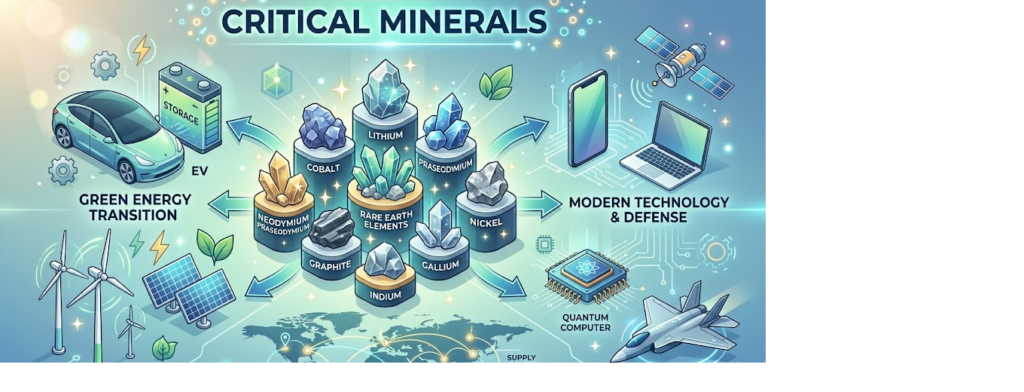
- Critical Minerals: These are metallic or non-metallic elements essential for modern technology, economic growth, and national security, but whose supply chains are highly vulnerable to disruption (e.g., Lithium, Cobalt, Nickel, Silicon).
- Rare Earth Elements (REEs): A specific group of 17 chemically similar metals (15 lanthanides, plus scandium and yttrium) that are irreplaceable in manufacturing high-tech electronics, electric vehicle (EV) motors, wind turbines, and defense equipment.
Significance for India
- Supply Chain Resilience: Deepens India’s economic security by reducing its near-total dependence on China for the processing and refining of critical minerals.
- Catalyzing High-Tech Manufacturing: Guaranteed access to critical minerals is a prerequisite for the success of India’s domestic aspirations in semiconductor manufacturing, AI development, and the EV transition.
- Access to Advanced Capital and Tech: The $20 billion Quad fund and the U.S. private sector mobilization will help India overcome its current deficit in heavy capital and advanced mineral processing technologies.
Present Global Supply Chain Scenario
- Chinese Dominance: China continues to control roughly 60% of global rare earth mining and 90% of processing capacity. Following trade escalations, China’s April 2025 export controls on seven heavy rare earth elements remain actively in force, creating persistent supply bottlenecks. An aggressive extraterritorial “0.1% rule” (Notice 61) is currently suspended but looms as a major disruption risk if reimposed in November 2026.
- Geopolitical Decoupling and “Friendshoring”: In response to supply chain weaponization, Western and allied nations are rapidly forming exclusive supply alliances. Key initiatives include the $20 billion Quad Critical Minerals Initiative Framework (U.S., India, Japan, Australia), the U.S.-led Pax Silica initiative, and the EU’s RESourceEU program, all designed to mobilize private capital and build alternative supply routes independent of China.
- Looming Deficits in Specific Metals: While investments in lithium, graphite, and rare earth mining are gradually diversifying, the International Energy Agency (IEA) projects significant long-term shortfalls for other crucial transition metals. Copper, in particular, faces a potential 30% supply deficit by 2035 due to declining ore grades, rising capital costs, and long project lead times.
- Pivot to Urban Mining and Recycling: To circumvent the long gestation periods of traditional mining and reduce geopolitical reliance, governments are heavily incentivizing a circular economy. The recovery of critical minerals from e-waste and scrap materials (urban mining) has become a central pillar of new industrial policies, explicitly prioritized in the Quad frameworks, U.S. domestic initiatives, and India’s National Critical Minerals Mission.
Challenges
- Long Gestation Periods: Setting up alternative mining and processing infrastructure is highly capital-intensive and takes years to become operational. In the short term, the reliance on China remains.
- Regulatory Frictions: Harmonizing domestic environmental, labor, and mining laws across four different Quad nations will require complex diplomatic and legislative maneuvering.
- Geopolitical Retaliation: Aggressive decoupling or “de-risking” efforts may invite further retaliatory trade barriers or export quotas from Beijing, triggering short-term price volatility in raw materials.
Way Forward
- Fast-Track Domestic Reforms: India must streamline its domestic mining regulations and auction processes to make the sector attractive to the private capital mobilized by these frameworks.
- Focus on E-Waste Mining: Urban mining—recovering rare earths from e-waste—should be heavily incentivized, as it reduces environmental degradation associated with traditional mining and leverages India’s massive electronics consumer base.
- Leverage Pax Silica: India should use its membership in the Pax Silica initiative to negotiate better technology transfer deals, ensuring it becomes a processing hub rather than just a raw material supplier.
Prelims Question
Q. Consider the following statements regarding the recent geopolitical initiatives concerning critical minerals:
- The Quad Critical Minerals Initiative Framework aims to mobilize around $20 billion to establish stable supply chains exclusively among its four member nations.
- The Pax Silica initiative, which India recently joined, is primarily aimed at securing supply chains for global food security and agricultural technologies.
- Rare Earth Elements (REEs) are a group of 17 metals that are critical for manufacturing advanced defense equipment and electric vehicles.
How many of the above statements are correct?
(a) Only one
(b) Only two
(c) All three
(d) None
Answer: (b) Only two
- Statement 1 is correct: The Quad framework aims to mobilize $20 billion for projects located in and operated by companies in Quad nations.
- Statement 2 is incorrect: Pax Silica is a U.S.-led initiative focused on securing supply chains for advanced technologies—especially semiconductors, AI infrastructure, and critical minerals—not agriculture.
- Statement 3 is correct: REEs comprise 17 chemically similar elements crucial for modern high-tech and green technologies.
Mains Question
Q. “Securing critical mineral supply chains is no longer just an economic necessity, but a pressing national security imperative.” In the light of the recent India-U.S. bilateral agreement and the Quad Critical Minerals Initiative Framework, analyze India’s strategic steps to reduce its vulnerability to single-source monopolies in critical technologies. (250 words)