Table of Contents
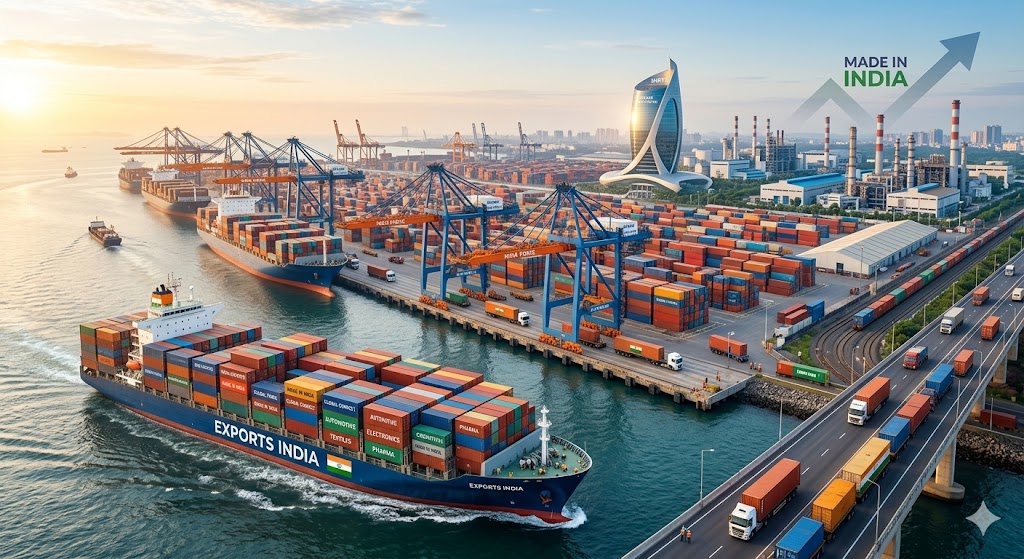
Official data released by the Ministry of Commerce and Industry shows that India’s merchandise exports hit a record high of $45.2 billion in May 2026. However, despite this robust export performance, the overall trade deficit widened due to an even sharper increase in imports.
Key Highlights of Trade Performance
- Merchandise Exports: Reached an all-time high of $45.2 billion (an 18% year-on-year increase from $38.3 billion in May 2025). The growth was broad-based, spanning both petroleum and non-petroleum sectors.
- Merchandise Imports: Surged by 22.1% to $73.4 billion, leading to a widened merchandise trade deficit of $28.2 billion (25% higher than in May 2025).
- Services Trade: Services exports grew by 13.2% to $36.8 billion, while services imports increased by 14.1% to $19.1 billion.
- Overall Trade Deficit: Even with the cushion provided by the services surplus, the combined overall trade deficit (goods + services) widened to $10.5 billion (up from $6.8 billion in May 2025).
- Key Export Destinations: The export rally was primarily driven by higher shipments to Singapore, China, the U.K., Tanzania, Bangladesh, Germany, and South Africa.
Sectoral Export Drivers
The record highs were fueled by strong performances across several core sectors in May 2026:
- Engineering Goods: Witnessed the most significant jump, growing by 24.5% to $12.3 billion.
- Organic & Inorganic Chemicals: Grew by 12.7% to $2.7 billion.
- Electronic Goods: Continued an upward trajectory, growing by 11.6% to $5.1 billion.
- Gems & Jewellery: Saw a steady growth of 6.7% to $2.5 billion.
- Note on Non-Petroleum Exports: Highlighting the strength of core manufacturing, India’s non-petroleum exports grew 10.5% to $70.7 billion in the first two months of the current financial year.
Trade Deficit Dynamics
- Widening Gap Due to Import Surge: Despite achieving historic export milestones, India’s overall trade deficit expanded to $10.5 billion in May 2026, up from $6.8 billion in the same month of the previous year.
- Outpacing of Foreign Sales: The primary driver behind the widening deficit is a massive 22.1% spike in merchandise imports, which hit $73.4 billion and comfortably outpaced the parallel growth in foreign sales.
- Standalones Merchandise Disparity: The standalone merchandise trade deficit experienced a sobering 25% increase compared to May 2025, climbing to a total of $28.2 billion for the month.
- Sign of Domestic Vitality: Rather than being a cause for immediate panic, market analysts view this widening deficit as a reflection of a rapidly expanding and hungry domestic economy importing heavily to fuel its own industrial and consumer momentum.
Services Surplus Cushion
- Resilient Growth in Services: India’s services exports acted as a strong buffer against the expanding merchandise deficit, climbing 13.2% year-on-year to lock in an impressive $36.8 billion.
- Offsetting the Merchandise Gap: While the merchandise trade sector alone faced a massive $28.2 billion deficit, the robust inflow from services significantly softened the blow to the overall ledger.
- Managed Intangible Imports: Services imports grew at a rate of 14.1% to reach $19.1 billion, allowing India to maintain a very strong net positive surplus in intangible trade.
- Net Softening of the Deficit: Thanks to the substantial net surplus generated by the services sector ($36.8 billion exported versus $19.1 billion imported), India’s final combined trade deficit was contained at a much more manageable $10.5 billion.
Way Forward
- Accelerating High-Value Domestic Manufacturing: To naturally narrow the trade gap, New Delhi must focus on scaling up high-value domestic manufacturing segments fast enough to match the consumer and industrial momentum. This will reduce reliance on importing expensive finished goods and crucial components.
- Leveraging Free Trade Agreements (FTAs): The government needs to prioritize the early implementation and rapid operationalization of newly signed pacts, such as the India-EU Free Trade Agreement. This will structurally dismantle non-tariff barriers and act as a primary catalyst to double bilateral trade.
- Diversifying and Boosting Merchandise Exports: India must sustain and expand its multi-sector offensive across broad-based segments like engineering goods, electronic goods, and chemicals by deepening ties with high-demand global markets.
- Transitioning to Advanced Tech and Services Orchestration: As traditional sectors face disruptions, Indian industries must pivot toward higher-order capabilities like Artificial Intelligence orchestration, deep-tech research, and advanced digital public infrastructure. This ensures that India moves up the global value chain from standard maintenance and execution to high-margin global consulting.
UPSC Prelims Practice Question
Q. Consider the following statements regarding India’s external trade sector:
- India traditionally maintains a deficit in its merchandise trade account but runs a surplus in its services trade account.
- An overall trade deficit indicates that the total value of goods and services imported by India is strictly less than the total value of goods and services exported.
- The engineering goods sector constitutes a negligible portion of India’s total merchandise export basket.
Which of the statements given above is/are correct?
(a) 1 only
(b) 1 and 2 only
(c) 2 and 3 only
(d) 1, 2 and 3
Correct Answer: (a)
- Statement 1 is correct: India relies heavily on imports for crude oil, gold, and electronics, leading to a persistent merchandise deficit. However, it consistently exports more services (IT, software, professional services) than it imports, creating a services surplus.
- Statement 2 is incorrect: An overall trade deficit implies that the value of imported goods and services exceeds the value of exported goods and services.
- Statement 3 is incorrect: Engineering goods are consistently one of the largest, most valuable, and fastest-growing components of India’s merchandise export basket.
UPSC Mains Practice Question
Q. “Despite achieving record highs in merchandise exports, India’s overall trade deficit continues to widen.” Analyze the structural reasons behind India’s persistent merchandise trade deficit and suggest policy measures to enhance the global competitiveness of its non-petroleum exports. (150 words, 10 marks)
Brief Approach for Mains:
- Introduction: State the recent data trend (e.g., record $45.2 billion goods exports in May 2026, yet a widening $10.5 billion overall deficit driven by a 22.1% import surge).
- Structural Reasons for the Deficit:
- Inelastic high import dependence on crude oil and gold.
- Heavy reliance on imported electronic components, APIs (Active Pharmaceutical Ingredients), and capital goods for domestic manufacturing.
- Surging domestic consumption outpacing domestic production capacities in certain sectors.
- Measures to Enhance Competitiveness:
- Manufacturing Base: Expanding the Production Linked Incentive (PLI) schemes to deepen domestic value chains in electronics and engineering.
- Logistics & Infrastructure: Reducing logistics costs through the rapid execution of the National Logistics Policy and PM Gati Shakti.
- Market Diversification: Expanding export footprints beyond traditional Western markets towards Africa, Latin America, and Southeast Asia.
- MSME Support: Upgrading MSME technology to boost the cost-competitiveness of chemicals, gems, and textiles.
- Conclusion: Conclude by emphasizing that while the services sector acts as a vital macroeconomic cushion, upgrading India into a globally competitive manufacturing hub is essential for long-term external sector stability.