Table of Contents
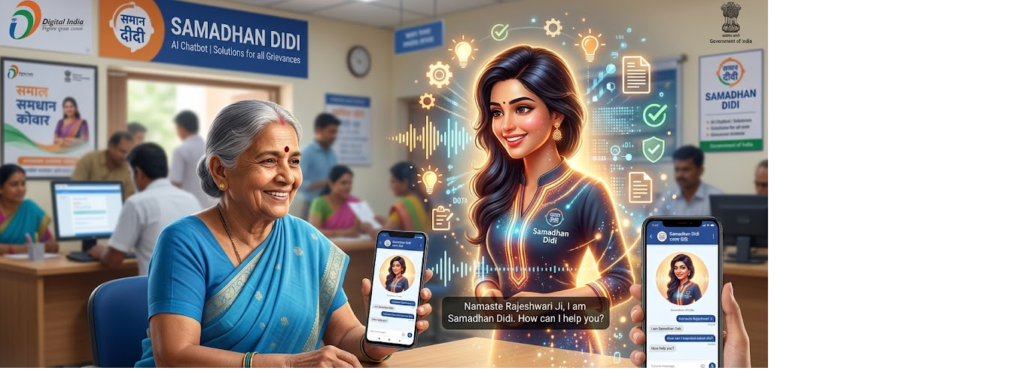
The Union Government has recently launched ‘Samadhan Didi’, an Artificial Intelligence (AI)-enabled chatbot designed to simplify and streamline the public grievance redressal mechanism in India.
About Samadhan Didi
- Developed by: The Department of Administrative Reforms and Public Grievances (DARPG) in collaboration with Bhashini (India’s AI-powered national language translation tool).
- Core Function: A multilingual, voice-enabled chatbot that allows citizens to lodge complaints against any government department simply by speaking in their native language.
- Termed as the “democratisation of the public grievance mechanism,” it shifts the burden of navigating complex bureaucratic structures from the citizen to technology, making governance more inclusive.
- Key Features:
- Automated Routing: Citizens no longer need to know which specific Ministry, department, or sub-category their issue falls under. The AI asks clarifying questions, identifies the correct authority, and files the grievance automatically.
- Multilingual Voice Support: Users can describe their problems in plain, everyday words using various Indian languages.
- Data Security: The chatbot operates entirely within secure government infrastructure to ensure the privacy of citizens’ data.
- The chatbot builds upon the existing CPGRAMS (Centralised Public Grievance Redress and Monitoring System) infrastructure.
- Rising Public Participation: The system has seen a massive paradigm shift. Grievance registrations have increased from roughly 2 lakh annually in 2014 to over 25 lakh annually today, reflecting deeper digital penetration and increased public trust in the redressal machinery.
Use of AI in Governance in India
India is actively shifting from traditional e-governance to an “AI-first” public infrastructure model. Anchored by the philosophy of “AI for All,” the government’s strategy focuses on democratizing access, ensuring digital inclusion, and building sovereign capabilities.
The recent India AI Impact Summit (February 2026) marked a major milestone, positioning India as a global leader in deploying AI for societal scale rather than just enterprise automation.
Here is a breakdown of how AI is currently deployed across Indian governance.
Foundational AI Infrastructure
To prevent reliance on foreign tech monopolies, India is building a sovereign AI stack.
- IndiaAI Mission: The government is subsidizing massive compute infrastructure, having onboarded over 38,000 GPUs (with a target of 100,000) for domestic startups and public deployment.
- AIKosh & Supercomputing: AIKosh currently hosts over 9,500 locally relevant datasets and 273 sectoral models. This is backed by the National Supercomputing Mission, which operates 40+ petaflop systems like AIRAWAT and PARAM Siddhi-AI.
Breaking Language Barriers & Accessibility
A core challenge in Indian governance is linguistic diversity. AI is being used to make digital services accessible to non-English speakers and non-literate users.
- Bhashini: India’s national AI translation mission creates open-source language models. It enables real-time voice and text translation across public service portals, allowing citizens to interact with the government in their native tongues.
Sector-Specific AI Deployments
AI is moving beyond pilot projects into large-scale integration across key public sectors:
| Sector | Key Initiatives & Impact |
| Agriculture | The 2026-27 Union Budget launched Bharat-VISTAAR, a multilingual AI tool. Integrated with AgriStack, it provides hyper-local, “farm-to-fork” advisories on soil moisture and pest outbreaks directly to farmers’ phones. |
| Healthcare | Through the Ayushman Bharat Digital Mission (ABDM), AI tools are deployed for early disease surveillance and automated diagnostic screening in rural clusters (e.g., AI-enabled TB screening). |
| Judiciary | Under e-Courts Phase III, tools like SUPACE and Digital Courts 2.1 are being utilized to assist judges with legal research and case management to tackle massive judicial backlogs. |
| Local Civic Admin | Municipalities are deploying AI for revenue and operations. For example, Chandigarh’s BIRBAL chatbot handles citizen services, while tools like SabhaSaar provide real-time transcription and summarization of Gram Sabha meetings. |
The 2026 AI Governance Guidelines
To manage the risks of algorithmic bias, data privacy, and the “black box” nature of AI, India introduced a new regulatory framework at the 2026 AI Impact Summit.
- The Seven Sutras: The framework is anchored in seven core principles, prioritizing trust, fairness, and accountability.
- DPDPA Alignment: AI systems deployed in India must comply strictly with the Digital Personal Data Protection Act (DPDPA). The guidelines mandate “Understandability by Design,” requiring organizations to prove how AI accesses sensitive data and explain how automated decisions are made.
- Human-in-the-Loop: For high-risk deployments (like welfare distribution or law enforcement), the guidelines ensure that humans retain meaningful control and oversight over AI-driven outcomes.
Significance: How AI is Transforming Governance
Access and Bridging the Divide
- Breaking Language Barriers: Tools like Bhashini (India’s national AI translation mission) are being integrated into public services to provide real-time voice and text translation.
- Grievance Redressal: The recently launched Samadhan Didi chatbot allows citizens to log complaints into the CPGRAMS portal simply by speaking in their native language, removing the need for digital literacy or understanding of complex bureaucratic structures.
Hyper-Efficiency in Local Administration
- Automating Bureaucracy: AI is streamlining routine administrative tasks. For instance, grassroots tools like SabhaSaar use AI to transcribe and summarize Gram Sabha meetings in real-time, ensuring local governance records are transparent, immutable, and instantly accessible.
- Targeted Welfare: Integrating AI with databases like Aadhaar and the Public Distribution System (PDS) helps identify ghost beneficiaries, detect fraud, and ensure targeted delivery of subsidies.
Revolutionizing Key Sectors
- Agriculture: Initiatives like Bharat-VISTAAR (a multilingual AI tool launched in the 2026-27 Union Budget) and the integration of AI with AgriStack provide farmers with hyper-personalized, “farm-to-fork” insights, significantly reducing crop failure risks.
- Healthcare: Through the National Health Stack, AI is shifting focus from curative to preventive care. AI-enabled tools are being deployed for early disease surveillance and automated diagnostic screening (e.g., TB screening) in underserved rural clusters.
Challenges in AI-Driven Governance
Algorithmic Bias and Exclusion Errors
If AI models are trained on historical or unrepresentative data, they can inherit and amplify societal biases. In governance, this could lead to the unfair denial of welfare benefits, discriminatory policing, or biased resource allocation.
Data Privacy and Cybersecurity
The vast amounts of citizen data required to train and operate AI systems make government databases prime targets. In 2025 alone, CERT-In handled nearly 30 lakh cyber incidents. As AI integration deepens, the threat of AI-driven ransomware and systemic vulnerabilities to India’s DPI increases.
The “Black Box” Problem (Lack of Explainability)
Many deep-learning algorithms operate as “black boxes”—meaning the system cannot clearly explain how it arrived at a specific decision. In public administration, where decisions must be legally justifiable and subject to appeal, deploying unexplainable AI violates principles of transparency and administrative justice.
Infrastructure and Compute Bottlenecks
While the IndiaAI Mission is actively deploying subsidized GPUs (graphics processing units) for domestic innovation, AI workloads are incredibly power-hungry. Scaling AI infrastructure requires massive data centers, which puts immense strain on India’s energy grid and necessitates a shift toward green compute power.
Way Forward
Strict Implementation of Techno-Legal Frameworks
India must rigorously enforce its AI Governance Guidelines (2025-26), which advocate a risk-based approach. High-risk use cases (like social scoring or emotion inference) must be strictly prohibited, and all AI systems should align with the Digital Personal Data Protection (DPDP) Act to ensure privacy by design.
Institutionalizing “Human-in-the-Loop”
To counter the black box problem, AI in governance should act as an augmenter, not an autonomous decision-maker. Critical services—especially those involving justice, welfare, or law enforcement—must mandate human oversight and a “kill switch” for automated systems.
Building Sovereign AI Capabilities
Continued financial backing of the IndiaAI Mission and the Anusandhan National Research Foundation (ANRF) is crucial. By building indigenous, culturally representative foundational models (like BharatGen), India can reduce reliance on foreign tech monopolies and ensure models understand local contexts.
Public Sector Capacity Building
Civil servants must be trained to procure, audit, and deploy AI responsibly. Expanding tech literacy initiatives through Mission Karmayogi will ensure that administrators understand both the potential and the limitations of algorithmic tools.
Prelims (PT) Practice Question
Q. Consider the following statements regarding the recently launched ‘Samadhan Didi’ initiative:
- It is an AI-enabled chatbot developed by NITI Aayog to provide financial literacy to rural women.
- It allows citizens to lodge public grievances using voice inputs in multiple Indian languages.
- It has been developed in collaboration with Bhashini.
Which of the statements given above is/are correct?
(a) 1 and 2 only
(b) 2 and 3 only
(c) 3 only
(d) 1, 2 and 3
Answer: (b) Explanation: Statement 1 is incorrect because it is developed by DARPG (not NITI Aayog) and deals with public grievances, not financial literacy. Statements 2 and 3 are correct.
Mains Practice Question
Q. “The true success of e-governance lies in its accessibility to the most marginalized.” In this context, discuss how the integration of Artificial Intelligence (AI) in grievance redressal mechanisms, such as the ‘Samadhan Didi’ chatbot, can transform citizen-centric governance in India. (150 words, 10 marks)
Brief Approach for Mains:
- Introduction: Define citizen-centric governance and briefly introduce ‘Samadhan Didi’ as a step in this direction.
- Body:
- Mention the limitations of traditional mechanisms (language barriers, complex departmental hierarchies, low digital literacy).
- Explain how AI tools solve these issues (automated routing saves time, voice-recognition bridges the literacy gap, Bhashini breaks language barriers).
- Highlight the broader impact (increased accountability, data privacy on govt servers, transition from 2 lakh to 25 lakh+ grievances showing scalable tech).
- Conclusion: Conclude with how AI-driven tools embody the “Minimum Government, Maximum Governance” vision, empowering the common citizen (democratisation of governance).