Table of Contents
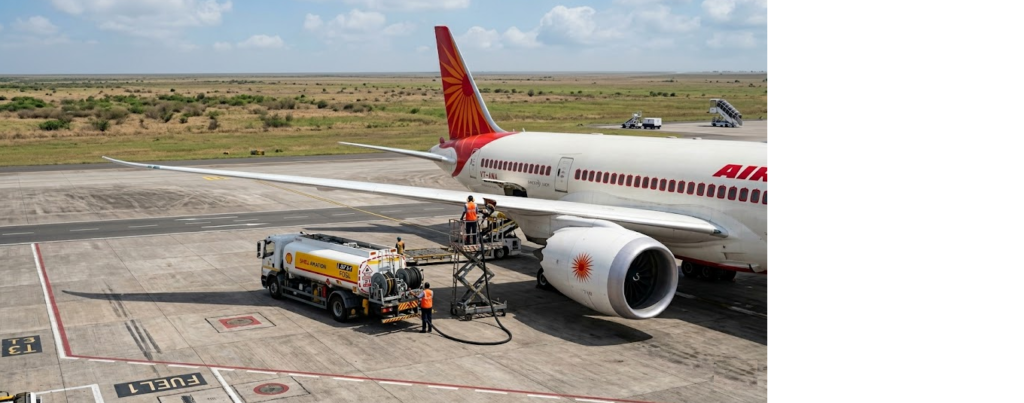
The Union Cabinet has approved a one-time budgetary support of ₹10,000 crore to create a Price Stabilisation Fund for Aviation Turbine Fuel (ATF). This initiative aims to cushion scheduled Indian airlines and passengers from escalating jet fuel prices triggered by the ongoing conflict in West Asia.
Key Features of the Stabilisation Fund
- Financial Structure: The ₹10,000 crore budgetary support will be provided as interest-free advances to state-run Oil Marketing Companies (OMCs). It is designed to function as a self-sustaining revolving fund.
- Coverage & Scope: The support is available exclusively to scheduled Indian airlines (foreign carriers are excluded) for both domestic and international flight operations.
- Implementation Mechanism: The fund will be operationalized through a Memorandum of Understanding (MoU) between OMCs and participating airlines. Under this agreement, airlines are mandated to procure ATF exclusively from OMCs for up to three years, or until the advance amount is fully recovered.
- Clawback/Recovery: The corpus compensates OMCs when international ATF prices exceed a predetermined benchmark. Once global prices moderate, the differential amount will be recovered from the OMCs and returned to the Consolidated Fund of India.
Why is this Intervention Needed?
- Geopolitical Fuel Shock: International ATF prices surged nearly 2.5 times—jumping from ₹60.5 per litre in March to ₹142 per litre in May—due to extreme energy market volatility driven by the West Asia crisis.
- High Operational Reliance: Jet fuel is a massive cost driver. ATF accounts for nearly 40% of airline operating costs under normal conditions, and can skyrocket up to 60% during periods of extreme fuel volatility.
- OMC Under-Recoveries: To shield consumers, the government had capped ATF prices at ₹75.6 per litre for domestic operations. Consequently, OMCs were incurring a massive under-recovery (loss) of ₹30 on every litre of ATF sold.
- Preventing Operational Disruption: Escalating costs forced major airlines like Air India and IndiGo to collectively cut down 250 daily domestic flights in June. This fund prevents further capacity reductions, curtails runaway airfares, and protects the financial viability of the aviation ecosystem.
- Geographical Constraints: The continued closure of Pakistani airspace has forced Indian flights heading to Europe, North America, and Central Asia to take longer routes, further increasing fuel consumption and operating costs.
Prelims Question
Q. With reference to the recently approved Aviation Turbine Fuel (ATF) Price Stabilisation Fund, consider the following statements:
- It is a one-time budgetary support provided directly to scheduled Indian airlines to offset their fuel costs.
- The fund operates as a self-sustaining revolving fund where advances will be recovered once international prices moderate.
- The facility covers both domestic and international operations of scheduled Indian carriers.
- Aviation Turbine Fuel is currently taxed under the maximum 28% GST slab.
Which of the statements given above are correct?
(a) 1 and 4 only
(b) 2 and 3 only
(c) 1, 2, and 3 only
(d) 2, 3, and 4 only
Answer: (b)
Explanation:
- Statement 1 is incorrect: The fund is provided as interest-free advances to Oil Marketing Companies (OMCs), not directly to the airlines.
- Statement 2 is correct: It is a self-sustaining revolving fund; once international prices cool down, the differential will be recovered and returned to the exchequer.
- Statement 3 is correct: It covers both domestic and international flights for Indian carriers.
- Statement 4 is incorrect: Aviation Turbine Fuel (ATF)—along with crude oil, petrol, diesel, and natural gas—is currently outside the ambit of GST.
Mains Examination Question
Q. The vulnerability of India’s aviation sector to global geopolitical shocks necessitates structural policy interventions rather than ad-hoc relief measures. Critically examine this statement in the context of the recent ₹10,000 crore Aviation Turbine Fuel (ATF) Price Stabilisation Fund. (150 words, 10 Marks)
Hints for Mains Answer:
- Introduction: Briefly mention the Cabinet’s approval of the ₹10,000 crore Price Stabilisation Fund to counter the 2.5x surge in ATF prices caused by the West Asia conflict.
- Merits of the Current Fund:
- Provides immediate liquidity and relief to OMCs dealing with ₹30/litre under-recoveries.
- Shields consumers from fare spikes and maintains critical regional (UDAN) and international connectivity.
- The fixed-price procurement mechanism provides operational and financial predictability for airlines.
- Limitations/Ad-hoc Nature:
- It is a temporary “revolving fund” dependent on international prices moderating in the future.
- It treats the symptom (price spike) but does not address the root causes of structural fuel taxation burdens.
- Need for Structural Interventions:
- Tax Rationalisation: Bringing ATF under the GST regime to allow airlines to claim input tax credit (currently subject to high and varying state VATs).
- Hedging Mechanisms: Encouraging airlines to adopt robust financial hedging strategies against global crude oil volatility.
- Alternative Fuels: Accelerating the adoption and blending of Sustainable Aviation Fuel (SAF) to reduce long-term import dependence.
- Conclusion: Conclude that while the stabilisation fund acts as a vital shock-absorber during crises, integrating ATF into GST and transitioning toward sustainable fuels are imperative for the long-term financial resilience of the Indian aviation sector.