Table of Contents
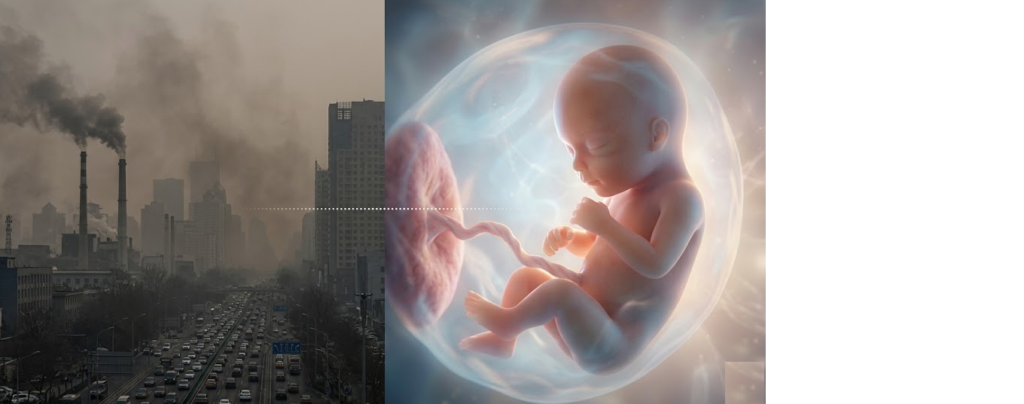
A pioneering study funded by the Indian Council of Medical Research (ICMR) and published in the journal EMBO Molecular Medicine has mapped the exact biological pathway through which urban air pollution breaches the placental barrier, leading to long-term developmental harm in fetuses.
Key Findings of the Study
While previous research established that environmental pollutants could cross the placenta, this study by researchers at AIIMS Delhi demonstrates the precise step-by-step molecular mechanism for the first time.
- Breaching the Barrier: Fine Particulate Matter () originating from urban air pollution successfully crosses the maternal-fetal interface (the placental barrier).
- The Inflammatory Cascade: Upon traversing the placenta, these fine particles trigger a massive wave of localized inflammation within the fetal environment.
- Protein Silencing: This induced inflammation directly leads to the epigenetic or functional silencing (shutting down) of a crucial fetal growth protein.
- Long-term Consequences: The suppression of this essential growth protein retards normal development, with health and cognitive consequences extending well beyond birth into late childhood.
Significance of the Study
- Shifting the Paradigm: Air pollution has traditionally been treated primarily as a respiratory or cardiovascular health crisis. This study elevates it to a developmental and multi-generational crisis.
- Intergenerational Health Impact: It provides concrete biomedical evidence explaining how high pollution loads in urban areas lead to Intrauterine Growth Restriction (IUGR) and low birth weight.
- Policy Implications: Highlights the urgent need for targeted public health interventions and environmental safeguards specifically tailored for pregnant women in heavily polluted urban centers.
[Urban Air Pollution (PM 2.5)] │ ▼ [Crosses Placental Barrier] │ ▼ [Triggers Fetal Inflammation] │ ▼ [Silences Fetal Growth Protein] │ ▼ [Lasting Harm into Late Childhood]
What is Air Pollution?
Air pollution refers to the contamination of the indoor or outdoor environment by any chemical, physical, or biological agent that modifies the natural characteristics of the atmosphere.
- Criteria Pollutants: Major pollutants monitored globally include Particulate Matter (PM 2.5 and PM 10), Nitrogen Dioxide (NO2), Sulphur Dioxide (SO2), Carbon Monoxide (CO), and Ground-level Ozone (O3).
- The Size Factor: Fine particulate matter (PM 2.5) is particularly dangerous because its microscopic size (less than 2.5 micro-meters in diameter—roughly 1/30th the width of a human hair) allows it to bypass natural respiratory filters.
Different Sources of Air Pollution
Air pollution sources are broadly classified into natural and anthropogenic (human-made) origins:
| Source Category | Primary Drivers & Pollutants |
| Industrial & Energy | Fossil fuel combustion in coal-fired power plants, manufacturing units, and oil refineries (releases high concentrations of $SO_2$, $NO_x$, and heavy metals). |
| Vehicular Emissions | Incomplete combustion of petrol and diesel in automobiles, releasing $CO$, unburnt hydrocarbons, and primary $PM_{2.5}$ in dense urban centers. |
| Agricultural Practices | Stubble burning (crop residue burning), which causes seasonal smog crises in northern India, and livestock farming (the largest source of agricultural methane, $CH_4$). |
| Domestic & Residential | Biomass burning (wood, dung cakes, crop residue) for cooking and heating in rural households, leading to severe Indoor (Household) Air Pollution. |
| Dust & Waste Construction | Road dust re-suspension, open waste burning in landfills, and construction activity generating massive amounts of coarse dust ($PM_{10}$). |
Impact of Air Pollution on Human Health
Air pollution acts as a systemic toxin, impacting multiple organ systems across a human lifespan:
- Respiratory System: Causes irreversible lung tissue damage, chronic obstructive pulmonary disease (COPD), aggravated asthma, and lung cancer.
- Cardiovascular System: Microscopic particles cross into the bloodstream, triggering vascular inflammation, arterial plaque buildup, oxidative stress, and significantly increasing the risk of ischemic heart disease and stroke.
- Neurodevelopmental Effects: Emerging research links chronic exposure to neuroinflammation, cognitive decline in elderly populations, and impaired cognitive development in children.
- The Fetal Frontier (AIIMS Delhi Landmark Finding):
- Placental Breach: Transports pollutants directly from the mother’s lungs across the maternal-fetal barrier.
- Epigenetic Silencing: Triggers a localized inflammatory response that effectively “turns off” proteins essential for cellular and tissue growth.
- Intergenerational Deficit: Results in Intrauterine Growth Restriction (IUGR), low birth weight, and developmental vulnerabilities that persist until late childhood.
Way Forward
Addressing air pollution requires an integrated, multi-sectoral strategy focused on enforcement, technology transition, and public health safeguards.
- Strengthening Policy & Enforcement: Tighten and strictly enforce ambient air quality standards under the National Clean Air Programme (NCAP), shifting from city-specific targets to a regional, airshed-management approach.
- Transition to Clean Energy: Accelerate the adoption of electric vehicles (EVs), expand public transit networks, and phase out coal dependencies by scaling up utility-scale renewable energy storage infrastructure.
- Promoting Circular Agriculture: Scale up targeted subsidies for ex-situ and in-situ crop residue management technologies (like the Pusa Decomposer or Happy Seeder machinery) to eliminate stubble burning.
- Targeted Prenatal Interventions: Integrate environmental health advisories into institutional maternal healthcare frameworks. Public health departments should prioritize providing clean-cooking energy infrastructure (e.g., PMUY LPG access) and establishing low-emission zones around healthcare facilities to shield pregnant individuals from peak exposure windows.
Prelims Test Questions
Q. Consider the following statements regarding a recent study on the impact of air pollution published in EMBO Molecular Medicine:
- The study maps how fine particulate matter () can cross the placental barrier in pregnant individuals.
- The fine particulate matter triggers inflammation that activates a vital fetal growth protein, leading to accelerated physical growth.
- The research was conducted by AIIMS Delhi and funded by the Indian Council of Medical Research (ICMR).
Which of the statements given above are correct?
(A) 1 and 2 only
(B) 2 and 3 only
(C) 1 and 3 only
(D) 1, 2, and 3
Answer: (C) 1 and 3 only
Explanation: Statement 2 is incorrect because the urban air pollution particles do not activate the growth protein; instead, they “silence” or shut down the essential growth protein, leading to restricted development that can persist into late childhood.
Mains Questions
Q. “Urban air pollution is no longer just a transient respiratory hazard; it poses a critical risk to the biological capital of future generations.” In the light of the recent AIIMS Delhi study, evaluate the multi-generational impact of ambient air pollution and suggest policy measures to mitigate this vulnerability. (150 Words, 10 Marks)
Model Approach
- Introduction: Begin by citing the landmark ICMR-funded study by AIIMS Delhi published in EMBO Molecular Medicine, which establishes how crosses the placenta and silences critical fetal growth proteins.
- Body:
- Biological & Developmental Impact: Explain the mechanism (Placental breach Inflammation Protein Silencing). Highlight that the resulting developmental deficits persist into late childhood, manifesting as stunted physical or cognitive growth.
- Socio-Economic & Human Capital Implications: Discuss how this degrades future human capital, increases the long-term non-communicable disease burden, and creates an economic drain on healthcare systems.
- Mitigation Strategies: Suggest targeted policy measures such as integrating prenatal care with environmental health advisories, setting up low-emission zones near maternity hospitals, strengthening National Clean Air Programme (NCAP) targets, and deploying air purification systems in public healthcare facilities.
- Conclusion: Conclude with a futuristic outlook, emphasizing that protecting clean air is fundamental to ensuring the right to health and development for the next generation.