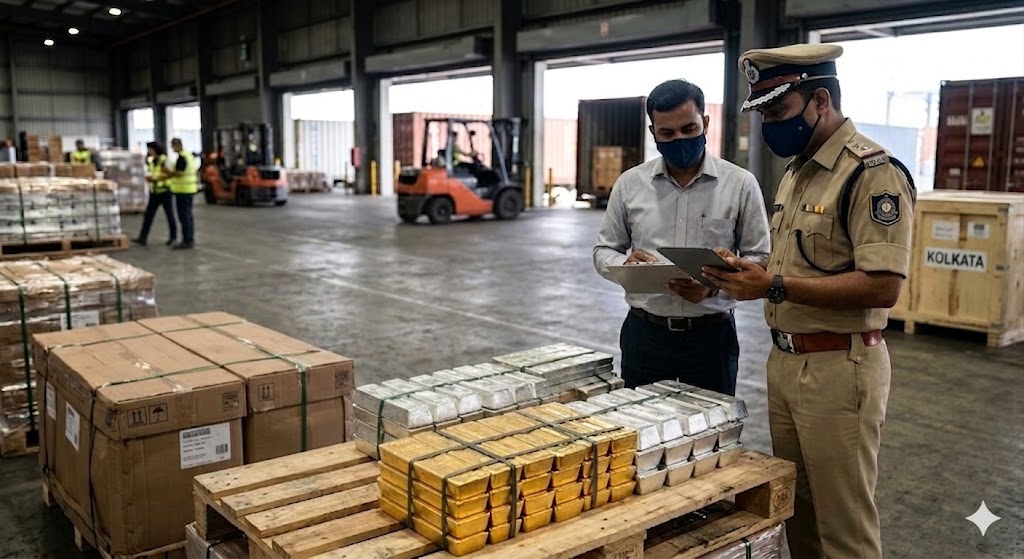
In a major fiscal move aimed at stabilizing the Indian Rupee and managing the Current Account Deficit (CAD), the Union Government has doubled the effective import duty on gold and silver. The total tax incidence has jumped from 9.2% to 18.4%, effective from May 13, 2026.
The Revised Tax Structure
The tax on precious metals in India is a combination of Basic Customs Duty (BCD), the Agriculture Infrastructure and Development Cess (AIDC), and the Integrated GST (IGST).
| Component | Previous Rate | New Rate (May 2026) |
| Basic Customs Duty (BCD) | 5% | 10% |
| Agriculture Cess (AIDC) | 1% | 5% |
| IGST | 3% | 3% |
| Total Effective Tax | ~9.2% | ~18.4% |
Rationale Behind the Hike
The government’s decision is driven by external economic pressures and a need for strategic prioritization of foreign exchange:
- Current Account Deficit (CAD) Management: India’s gold imports reached $71.9 billion in 2025-26 (a 24% increase). Such massive outflows of foreign exchange put pressure on the CAD.
- West Asia Crisis: Geopolitical volatility has led to a spike in crude oil prices and shipping costs. As a massive oil importer, India must conserve its USD reserves to pay for “essential imports” like fuel, fertilizers, and defense equipment.
- Currency Stability: Reducing the demand for “non-essential” imports like gold helps prevent the depreciation of the Indian Rupee against the Dollar.
- Prioritization of Resources: The government is shifting focus towards industrial raw materials and critical technologies over consumption-driven precious metals.
Key Concerns and Criticisms
Industry experts and bodies like the GJEPC (Gem & Jewellery Export Promotion Council) have raised several red flags:
- Incentivizing Smuggling: Historically, high import duties in India have led to a surge in grey-market activities and gold smuggling, as the price gap between domestic and international markets widens.
- MSME Liquidity Crunch: Small and Medium Enterprises (MSMEs) form 80% of the jewelry industry. Higher duties lead to blocked capital and a severe liquidity crisis for these manufacturers.
- Transparency Issues: The Global Trade Research Initiative (GTRI) noted that the notifications are “layered” and complex, making it difficult for businesses to determine the actual applicable duty, which contradicts the “Ease of Doing Business” objective.
- Impact on Exports: Higher domestic gold prices can make Indian jewelry exports less competitive in the global market.
Important Concepts for UPSC
- Current Account Deficit (CAD): The difference between the value of a country’s imports of goods and services and the value of its exports. Gold is often cited as the second-largest contributor to India’s CAD after crude oil.
- AIDC (Agriculture Infrastructure and Development Cess): A dedicated fund used to finance the improvement of agriculture infrastructure.
- Inelastic Demand: Economists argue that gold demand in India is culturally “inelastic,” meaning high prices often fail to significantly reduce consumption, instead shifting it to unauthorized channels.
Practice Questions
Preliminary Test Question
Q. With reference to the taxation of gold imports in India, consider the following statements:
- The Agriculture Infrastructure and Development Cess (AIDC) is a component of the total effective import tax on gold.
- Increasing the import duty on gold is a strategy primarily used to reduce the Current Account Deficit (CAD).
- The IGST on gold imports is calculated solely on the Basic Customs Duty, excluding the cost of the metal.
Which of the statements given above is/are correct?
A) 1 and 2 only
B) 2 and 3 only
C) 1 and 3 only
D) 1, 2, and 3
Answer: A) 1 and 2 only. (Statement 3 is incorrect: IGST is calculated on the total assessable value, which includes the cost, insurance, freight, and all applicable customs duties.)
Mains Practice Question
Q. “Using high import duties as a tool to curb gold consumption in India is often described as a ‘blunt instrument’ that yields diminishing returns.” Critically analyze this statement in the context of India’s foreign exchange management and the risk of a burgeoning parallel economy. (250 Words)