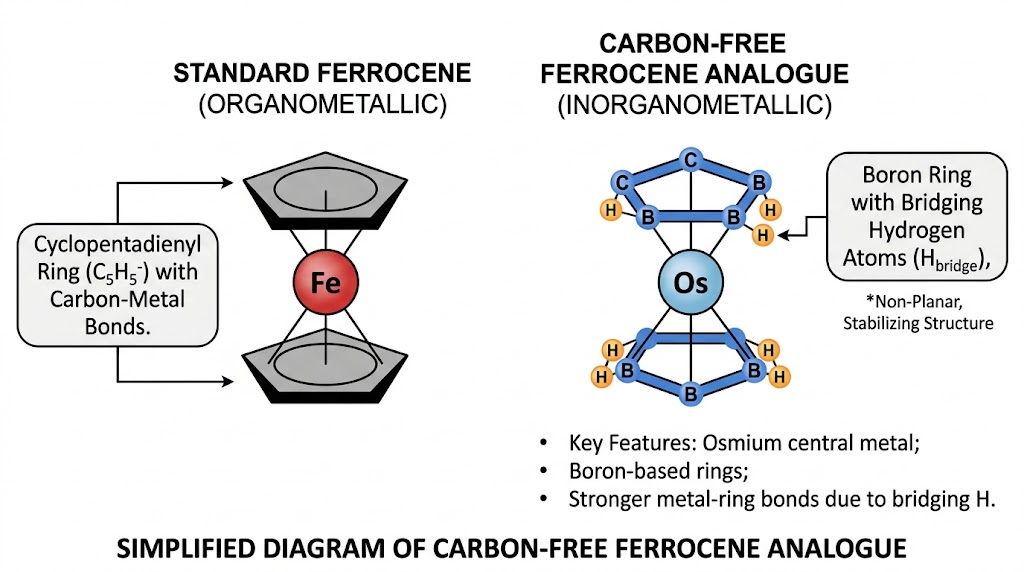
Recently, researchers from IIT-Madras and the Indian Institute of Science (IISc), Bengaluru, published a pathbreaking study in the journal Science. They successfully synthesized the first stable, completely carbon-free inorganic analogue of ferrocene using boron rings and the transition metal osmium.
Background: The Significance of Ferrocene
- What is Ferrocene? Discovered over seven decades ago, ferrocene is an organometallic compound consisting of a single iron (Fe) atom “sandwiched” between two flat, parallel carbon rings (cyclopentadienyl rings).
- Historical Impact: The discovery of ferrocene established the field of organometallic chemistry (the study of chemical compounds containing at least one chemical bond between a carbon atom of an organic molecule and a metal).
- Applications: It revolutionized materials science, catalysis, and medicine.
For decades, a major holy grail for inorganic chemists was to recreate this unique “sandwich” architecture without using any carbon atoms.
The New Breakthrough: Boron-Osmium Sandwich
Structural Configuration
- The Components: Instead of carbon and iron, the new inorganic compound uses two 5-membered boron rings sandwiching a single osmium (Os) atom.
- The Hydrogen Bridges: Unlike the completely flat carbon rings in traditional ferrocene, the boron rings in this compound contain bridging hydrogen atoms between the boron atoms.
Key Chemical Features
- Stronger Bonding: The bridging hydrogen atoms redirect the electron orbitals of the boron ring directly toward the central osmium metal. This unique orientation creates a chemical bond that is significantly stronger than the iron-carbon bond in traditional ferrocene.
- Method of Synthesis:
- Scientists used computer modeling to predict that osmium would provide the best structural stability for a pure boron sandwich.
- A polymeric osmium-bromine precursor was reacted with an excess of a borane-dimethyl sulphide reagent.
- The mixture was heated at 100°C for eight hours to isolate a stable, colourless solid.
- The molecular architecture was verified using X-ray diffraction and Nuclear Magnetic Resonance (NMR) spectroscopy.
Significance and Potential Applications
- Birth of ‘Inorganometallics’: The discovery fundamentally proves that sandwich molecular architectures are not exclusive to carbon-based organic chemistry. It marks the transition from organometallic to a new era of inorganometallic chemistry.
- High-Temperature Catalysts: Because the boron-osmium bonds are stronger than those in ferrocene, these compounds are expected to remain stable at much higher thermal thresholds, opening pathways for resilient industrial catalysts.
- Advancements in 2D Materials: This synthesis aligns with the recent global renaissance in the 2D chemistry of boron (borophene). It opens concrete possibilities for developing metal-sandwiched/intercalated bilayers and multilayers, which could revolutionize future electronics, energy storage, and nanotechnology.
Practice Questions
Prelims Test (PT) Question
Q. Consider the following statements regarding the recently synthesized carbon-free analogue of ferrocene:
- It is an inorganic sandwich compound synthesized indigenously by Indian researchers using boron and osmium.
- Unlike traditional ferrocene, it lacks a sandwich molecular architecture.
- The presence of bridging hydrogen atoms in this new compound results in a bond stronger than that found in carbon-based ferrocene.
Which of the statements given above are correct? (a) 1 and 2 only
(b) 2 and 3 only
(c) 1 and 3 only
(d) 1, 2 and 3
Answer: (c)
- Explanation: Statement 1 is correct; the breakthrough was achieved by teams from IIT-Madras and IISc Bengaluru using boron rings and osmium. Statement 2 is incorrect because the discovery explicitly confirms that a perfect “sandwich” architecture can be maintained even without carbon. Statement 3 is correct; the bridging hydrogen atoms redirect electron orbitals towards the metal, rendering the bond stronger and potentially more heat-stable than traditional ferrocene.
Mains Question
Q. What do you understand by ‘sandwich architecture’ in coordination chemistry? Discuss the scientific and industrial significance of the recent indigenous synthesis of a carbon-free analogue of ferrocene. (150 Words, 10 Marks)